
| CSS\Adventurer Trucks | Sweptline Power Wagons | Medium/Heavy Duty Trucks |
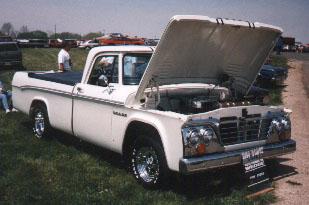
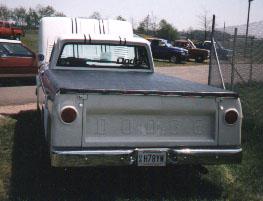
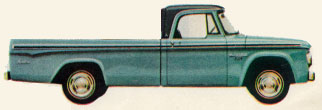
Custom Sport Special Pickups were made available from 1964 to 1967 equipped with an optional package that added comfort, sporty looks and in some cases, extra power under the hood.
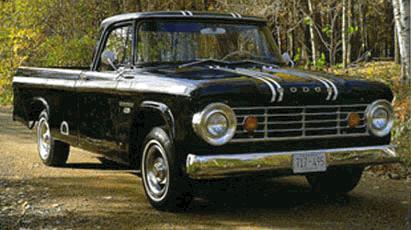
The CSS started out as a concept vehicle which was sent out into the real world. Multiple trucks were produced with various enhancements expressly for media testing as an option possibility for future Sweptline Era Trucks. These pickups were sometimes called "Palomino" trucks, as some Chrysler ads and magazine road tests have shown. To view these road test articles, click the links below:
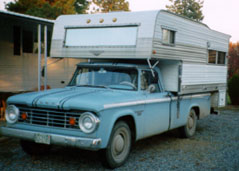 Nearly any tonnage or body style could have the package, but most that are
known to be equipped with it are of the half or three-quarter
ton pickup variety. Some owners think that the stripes, because they are
so simplistic, are silly aftermarket or add on items installed by previous
owners. On the contrary, these stripes are the only true body markings
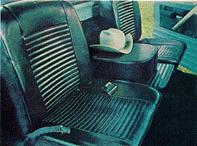
that designate the CSS. Unless one can see the bucket seats and interior
differences, there are only the stripes to set these trucks apart.
Nearly any tonnage or body style could have the package, but most that are
known to be equipped with it are of the half or three-quarter
ton pickup variety. Some owners think that the stripes, because they are
so simplistic, are silly aftermarket or add on items installed by previous
owners. On the contrary, these stripes are the only true body markings
that designate the CSS. Unless one can see the bucket seats and interior
differences, there are only the stripes to set these trucks apart.Trucks without the 426 wedge engine came equipped with the bucket seats, steering wheel with large horn ring, full coverage carpet, and stripes but were manufactured without the specialty gauges. Stripes came in a contrasting color of black for light body hues and white for darker paint jobs, much like how standard trim levels contrasted body color.
 |
 |
|---|---|
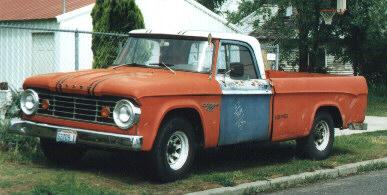
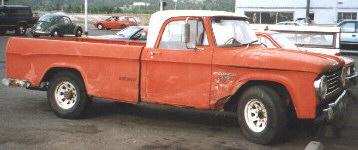
| Picture of truck from rear. | Front end photo. |
| (Photos courtesy of Tom Stroup.) | |
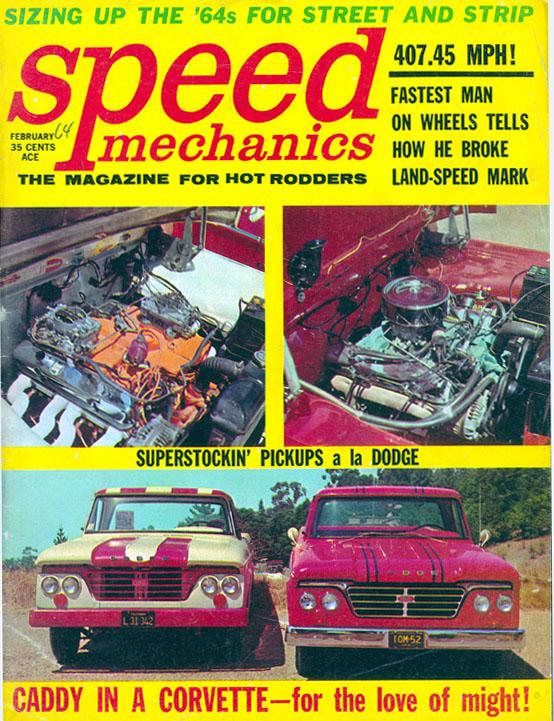 | Take a good look at this image from the cover of Speed Mechanics, The Magazine for Hot Rodders circa February `64. (Click here or the image on the left for the larger version) At about this time was the introduction of the CSS, and by looking at this it's easy to see how big a hit these trucks were. Hmm, are those fenderwell headers on the left-side truck? Of course! They, along with dual quads on top of the infamous crossram intake adorn the 426 Max-Wedge motor. (Special thanks to Steve Dreibelbis of Bernville, PA for submitting this image) (File Size: 105K) |
|---|
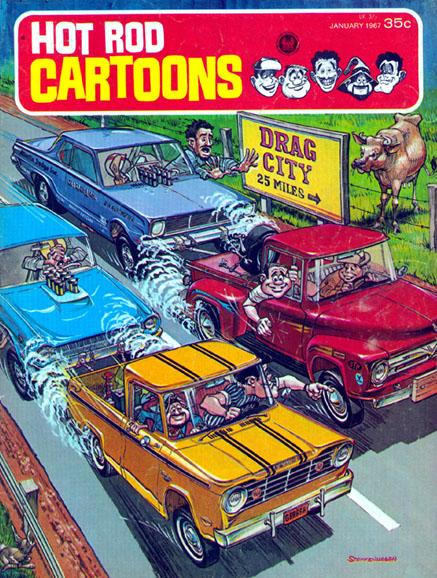 | Here's an image which depicts a Custom Sport Special Pickup in cartoonish form leading a pack of hot rodders onto some racing. Note the wimpy F*#d product included in the image. It seems kinda out of place (perhaps it serves as a bad example of a pickup). (File Size: 81.5K) (Submitted by Steve Dreibelbis) |
|---|
Do you know where a CSS is located?? If you do, the proprietor of this Website would like to get pictures of the truck and some information about it. You will be reimbursed for film and/or developing if you desire. Please e-mail moparman@wsunix.wsu.edu or use the Online Response Page for more info.
 The CSS package was undoubtedly the
inspiration for the Adventurer trim level, available first in 1968. This package
complemented the availability of the 383 big-block engine, a welcome addition in
everyone’s book from ‘67. The Adventurer trucks possessed more visually obvious
clues than the CSS, and were far more popular in sales numbers. No paint and
tape alterations were made to Adventurers, instead, chrome "Adventurer" badges
adorned the rear quarters of the bed and a vinyl covering was added to the roof
for a soft-top look.
The CSS package was undoubtedly the
inspiration for the Adventurer trim level, available first in 1968. This package
complemented the availability of the 383 big-block engine, a welcome addition in
everyone’s book from ‘67. The Adventurer trucks possessed more visually obvious
clues than the CSS, and were far more popular in sales numbers. No paint and
tape alterations were made to Adventurers, instead, chrome "Adventurer" badges
adorned the rear quarters of the bed and a vinyl covering was added to the roof
for a soft-top look.The Adventurer was aimed at attracting the booming market of camper buyers to tough Dodge trucks with unique features. Many buyers realized that with bucket seats, the optional power of a 383 engine, and the Adventurer package, these Dodge trucks were well suited for rough duty with good looks and plush interior comforts to match.
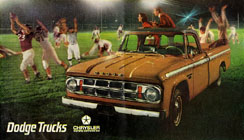
Image from Dodge Truck
Advertisement.
 Among the options included with the Adventurer
package were such refinements as a chrome grille and front bumper, body-side trim,
carpet(as opposed to the rubber mat), specialty steering wheel with chrome horn
ring, chrome dash accents, cab drip-rail chrome, headliner, and extra insulation
throughout. For extra, one could opt for bucket seats and a center console or a
chrome rear bumper. Adventurer pickups were available through the '71 model year,
in which case the package was available in three similiar forms. Along with the
Adventurer, newly available was the Sport or S.E. designation. More for sales
than for extra options, these levels gave the buyer a wider selection of specific
features to choose from.
Among the options included with the Adventurer
package were such refinements as a chrome grille and front bumper, body-side trim,
carpet(as opposed to the rubber mat), specialty steering wheel with chrome horn
ring, chrome dash accents, cab drip-rail chrome, headliner, and extra insulation
throughout. For extra, one could opt for bucket seats and a center console or a
chrome rear bumper. Adventurer pickups were available through the '71 model year,
in which case the package was available in three similiar forms. Along with the
Adventurer, newly available was the Sport or S.E. designation. More for sales
than for extra options, these levels gave the buyer a wider selection of specific
features to choose from.
| Adventurer Promotional Materials | |
|---|---|
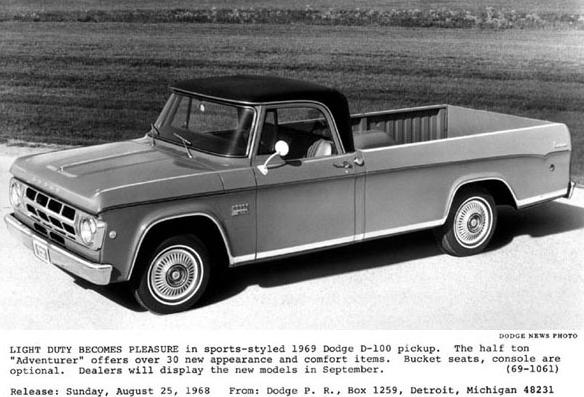 | This is an image of a press photo as released by Dodge on August 25th, 1968. You can see in the photo that this truck has the round reflectors on the front and rear quarter panels. These were OEM items until later (1970) when rectangular turn signals replaced them in the same location. (Submitted by Steve Dreibelbis)(File Size: 45.5K) |
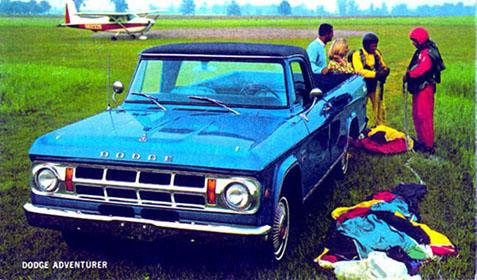 | At right is an image of a Dodge promotional postcard featuring a beautifully blue `69 Adventurer at play with some skydivers. Note the lower body trim, wheel covers and hood mounted turn signal indicators on this truck. (Submitted by Steve Dreibelbis)(File Size: 35.9K) |
 | This is an image of a 1971 Dodge Adventurer Truck promotional postcard. It was pretty much like any other postcard, but it had a pre-printed message on the reverse side which described the qualities of a `71 Adventurer. (Submitted by Chris Lublin)(File Size: 20K) |
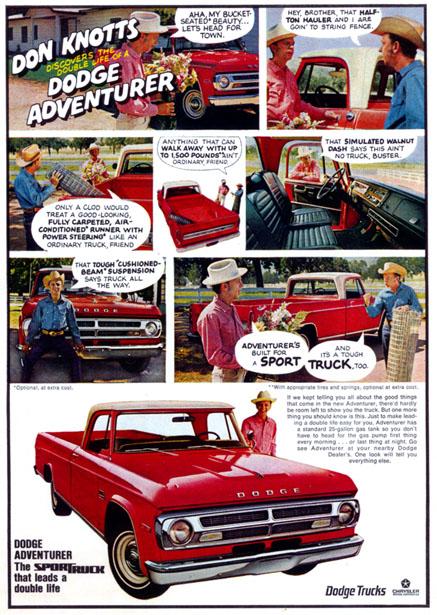 | At left is a scan of a more famous Dodge Truck ad which features Don Knotts and, well, Don Knotts. The ad discusses the finer points of a `71 Adventurer pickup.(File Size: 76K) (Submitted by Steve Dreibelbis) |