| CSS\Adventurer Trucks | Sweptline Power Wagons | Medium/Heavy Duty Trucks |
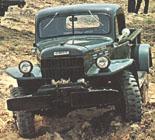
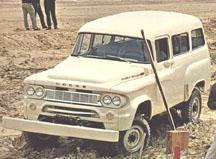
All of these trucks are distinguished by large chrome lettering that spells out "Power Wagon" across the sides of the hood. Sweptline Trucks after '68 had the badge positioned on the sides of the fender below the "Dodge" emblem. With the introduction of the Sweptline body design, Dodge carried on the tradition of tough 4x4 vehicles, with good looks. This page will evaluate the Sweptline Power Wagon Trucks, so if you're interested in some of the Town Panel, Town Wagon or WM-300 versions, be sure to check out The Dodge Power Wagon Website maintained by Joe Cimoch or Jay's Dodge Power Wagon Page. Both are jam-packed with useful information, links and Power Wagon photos. Also, on the Parts Sources Page there are a few good Power Wagon parts sources which apply to most Power Wagon vehicles, military or civilian. For more links, check the Links page.
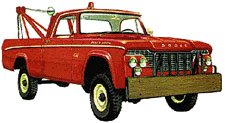
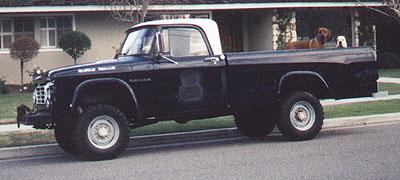
 1961 marked the first year for Sweptline
Era Power Wagons, and these trucks posessed the tough drivetrain features of
their predecessors built around a new chassis to go with the redesigned body
style. W-300 Sweptline models continued with the larger L-Head six, as well
as an optional Wideblock V8 engine, both mounted on a straight frame.
Similiarly, D-300 and larger trucks had a straight frame as opposed to the
drop center frame developed for the 1961 and later Sweptline trucks.
Otherwise, Sweptline W-100 and W-200 models came standard with the Slant-six
while the 318 Polysphere V-8 was optional.
1961 marked the first year for Sweptline
Era Power Wagons, and these trucks posessed the tough drivetrain features of
their predecessors built around a new chassis to go with the redesigned body
style. W-300 Sweptline models continued with the larger L-Head six, as well
as an optional Wideblock V8 engine, both mounted on a straight frame.
Similiarly, D-300 and larger trucks had a straight frame as opposed to the
drop center frame developed for the 1961 and later Sweptline trucks.
Otherwise, Sweptline W-100 and W-200 models came standard with the Slant-six
while the 318 Polysphere V-8 was optional.
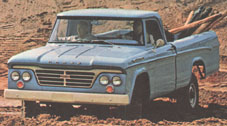
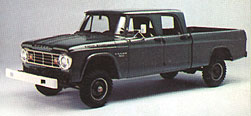 In spring 1965, Dodge Power Wagon
Pickups received the same apperance changes that were made to the stardard
duty trucks. A new, single headlight grille covered the front end while a
longer wheelbase and more versatile box revamped the rear end of the
trucks. They could be had with a bright trim Apperance package that added
aluminum trim along the upper portions of the body. This trim was painted
with a contrasting color inside of black or white depending on the body
color of the truck. Other packages like the Comfort package or the CSS
package allowed for further interior and trim improvement over the standard
vinyl covered bench seat and otherwise plain interior.
In spring 1965, Dodge Power Wagon
Pickups received the same apperance changes that were made to the stardard
duty trucks. A new, single headlight grille covered the front end while a
longer wheelbase and more versatile box revamped the rear end of the
trucks. They could be had with a bright trim Apperance package that added
aluminum trim along the upper portions of the body. This trim was painted
with a contrasting color inside of black or white depending on the body
color of the truck. Other packages like the Comfort package or the CSS
package allowed for further interior and trim improvement over the standard
vinyl covered bench seat and otherwise plain interior.
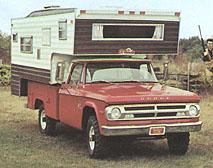
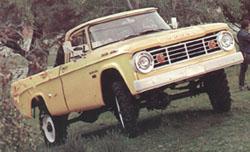 D-200 Trucks could be upgraded with the Camper Special package. This added
"bigger and better" equipment in the areas of cooling, electrical,
suspension (stronger leaf springs), tires, wheels, and also added extra
emblems to the doors under the vent wing window. The Comfort and Apperance
packages mentioned above were also available with the Camper Special
package.
D-200 Trucks could be upgraded with the Camper Special package. This added
"bigger and better" equipment in the areas of cooling, electrical,
suspension (stronger leaf springs), tires, wheels, and also added extra
emblems to the doors under the vent wing window. The Comfort and Apperance
packages mentioned above were also available with the Camper Special
package.The year 1966 was much like '65 in regards to standard and optional equipment on Sweptline and Utiline Power Wagons. Late 1967 saw the change from the large bezel grille to a more straightforward rectangular version that was available in bright aluminum or painted steel. '67 also marked the last year for the available CSS package, its replacement being the Adventurer Package for '68.
1968 was significant for the Power Wagon Trucks since the 383ci V-8 was added as an option. In this year, the Adventurer package was added as an option to the two-wheel drive truck line but was not available on four-wheel drive models. Also, a full width rear window was made standard in '68 for greater visibility.
More body and apperance changes were made along with a number of interior improvements to the 1969 model year Power Wagons. These changes included a more modern hood and bumper design as well as a change to the emblems on the trucks. Instead of the large chrome "POWER WAGON" lettering down the sides of the hood, the designation was now much smaller and was positioned below redesigned tonnage emblems on each front fender below the cowl. A new dash design was introduced which included a full width pad along the top edge, flip up glove box access, and a totally new instrument cluster integrated amongst the various controls. Seat belts were now of the retractable type and were housed in plastic matched to the interior. Inside door handles became smaller and were supported on a fiberglass panel which was colored similiar to the rest of the interior. Mechanically a new, single lever operated transfer case allowed for quicker shifting, increased durability and quieter operation.
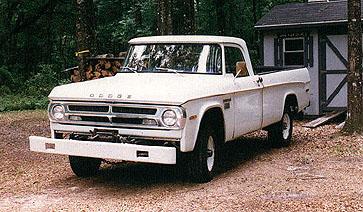
A new aluminum grille was the bulk of changes for 1970 and was installed on W-100 and W-200 Trucks. A painted steel version of the same grille was available on W-300 models. The three-speed Loadflite automatic transmission was optional while the standard three-speed in six-cylinder powered trucks was made completely syncromesh for better operation.